
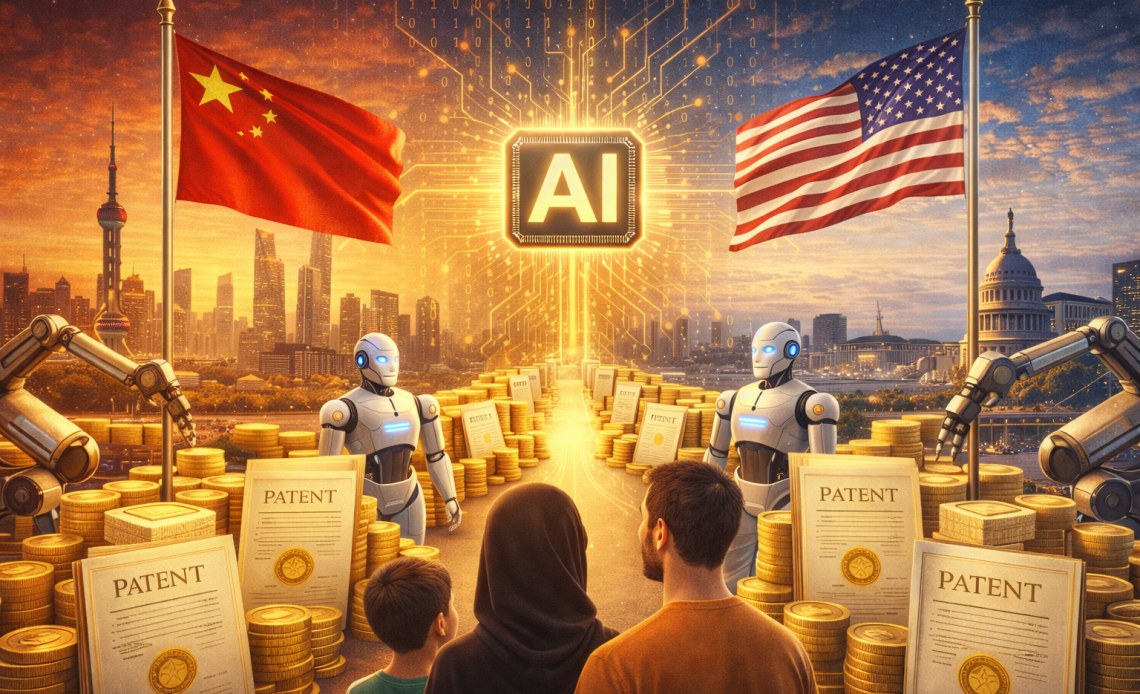
Something interesting is happening in the world of AI patents, and if you’re working on anything involving artificial intelligence or machine learning, you need to pay attention.
For years, getting a patent for AI-related inventions felt like playing a rigged game—especially in the United States, where the rules around what could even be patented seemed designed to make you give up. But that’s changing, and it’s changing fast. Both China and the U.S. are now actively encouraging people to file AI patents, which is a pretty dramatic shift from where things stood just a couple years ago.
The timing isn’t coincidental. Both countries are locked in what everyone’s calling an AI race, and they’ve apparently figured out that if you want your domestic AI industry to thrive, maybe don’t make it nearly impossible for inventors to protect their work.
Jump Ahead To:
China’s Decided AI Patents Are Actually Good Now
Let’s start with China, because they’ve been surprisingly direct about what they want. The China National Intellectual Property Administration—CNIPA for short—has basically come out and said: we want AI patent applications, and we’re going to make it easier for you to get them approved.
Last December, they launched something called “Pilot Guidance” that spelled out exactly when AI inventions would be considered “technical” enough to deserve patent protection. The criteria are pretty broad, too. If your AI model processes technical data, if it has specific connections to computer hardware, or if it analyzes massive amounts of data to find patterns—even patterns that reflect natural laws—you’re probably good to go.
That’s a big deal. In the past, you could spend months or years trying to convince patent examiners that your invention was “technical” enough. Now China’s basically saying, “Yeah, AI stuff is technical. Stop overthinking it.”
They’ve even added new examples to their guidelines showing exactly what kind of AI patent claims they’d approve. Neural network models? They’ve got sample claims for that now. It’s like they’re trying to make this as easy as possible, which is… unusual for patent offices, frankly.
But here’s where it gets a bit more complicated—they’re not giving everyone a free pass. China’s made it clear that if your AI invention violates other laws or crosses ethical lines, you’re not getting a patent. They’ve given some pretty specific examples: a mattress sales system that secretly scans customers’ faces without permission? Nope, that violates privacy laws, no patent for you. An autonomous vehicle system that decides who to hit in an accident based on their age or gender? Absolutely not, that’s morally reprehensible.
So it’s more permissive, but not a free-for-all. They’re drawing lines where they think lines need to be drawn.
China’s now sitting on about 60 percent of all AI-related patents globally, which is kind of mind-blowing when you think about it. And they’ve explicitly said they plan to keep promoting AI patent filings. They’re not subtle about their ambitions here.
The U.S. Patent Office Has a New Boss, and He’s Pro-AI
Over in the United States, things are shifting too, though it’s happening a bit differently.
The USPTO just got a new director named John A. Squires, and one of the first things he did after getting sworn in was basically announce that America is “open for business” for emerging technologies. He specifically called out AI, crypto, quantum computing, and diagnostics as areas with “breathtaking opportunities.”
Now, you might think that’s just typical government official talk, but Squires has backed it up with actual decisions. He convened something called an Appeals Review Panel and issued a ruling in a case called Ex parte Desjardins that was pretty explicitly pro-AI patent.
In that decision, Squires acknowledged that U.S. patent law around what counts as patentable subject matter has become “confusing”—which is putting it mildly, honestly—and then said something remarkable: excluding AI innovations from patent protection “jeopardizes America’s leadership in this critical emerging technology.”
That’s not bureaucratic fence-sitting. That’s a patent office director saying, “Look, we need to approve these patents or we’re going to fall behind.”
He also told patent examiners to stop evaluating AI claims “at such a high level of generality,” which has been a common way to reject AI patents. Instead, he said they should look for technical improvements in things like optimization of machine learning models. That’s a real shift in how these applications get reviewed.
Even before Squires took over, there were signs the USPTO was loosening up. Back in August, Deputy Director Charles Kim sent out a memo reminding examiners to be more careful about rejecting AI applications. The memo told them that if they’re facing a “close call” on whether something’s patentable, they should only reject it if it’s more than 50 percent likely to be ineligible.
That might sound like splitting hairs, but in patent law, shifting the benefit of the doubt like that is huge. Patent attorneys have already been citing this memo successfully to get previously rejected applications approved.
So What Does This Actually Mean?
If you’re sitting on an AI invention and you’ve been hesitant to file a patent because you figured it’d just get rejected anyway, this is probably your moment. Both China and the U.S. have created the most favorable environment for AI patents that we’ve seen in years, maybe ever.
But—and this is important—don’t take “more favorable” to mean “sloppy applications will work fine now.” AI patents are technically complex, and if you file a weak application with poor documentation, you’re still going to have problems. The doors are opening, but you still need to walk through them properly.
The guidance from both countries emphasizes that you need to thoroughly document things like training steps, parameters, how your input and output data works, and what specific technical problems your invention solves. That stuff has always mattered, but now that patent offices are actually willing to approve these applications, getting those details right matters even more.
There’s also a strategic element here that’s worth considering. Both countries are essentially saying they view AI patents as a national priority. They’re not just tolerating these filings—they’re actively encouraging them because they see patent portfolios as part of winning the broader AI competition.
That means if you wait too long, you might find yourself competing for patent protection in increasingly crowded space. First-mover advantage still exists in patent law, and right now, the field is wide open in ways it hasn’t been before.
The Window Won’t Stay Open Forever
Here’s the thing about shifts in patent policy: they can shift back. Director Squires could leave the USPTO in a few years, and his replacement might have different priorities. China’s approach could change if their political or economic situation changes. Nothing in patent law is permanent.
Right now, though, both countries are saying essentially the same thing: we want AI patents, we’re going to make it easier to get them, and we see this as strategically important for our national interests. That alignment is rare, and it probably won’t last forever.
If you’ve been developing AI technology and wondering whether it’s worth the hassle and expense of filing patents, the answer right now is probably yes. Not because patents are suddenly easy—they’re not—but because the people examining them are finally willing to take AI innovations seriously as legitimate technical advances worth protecting.
Just make sure you work with patent attorneys who actually understand AI, because the technical complexity hasn’t gone away. The doors are open, but you still need to know how to walk through them without tripping.
