
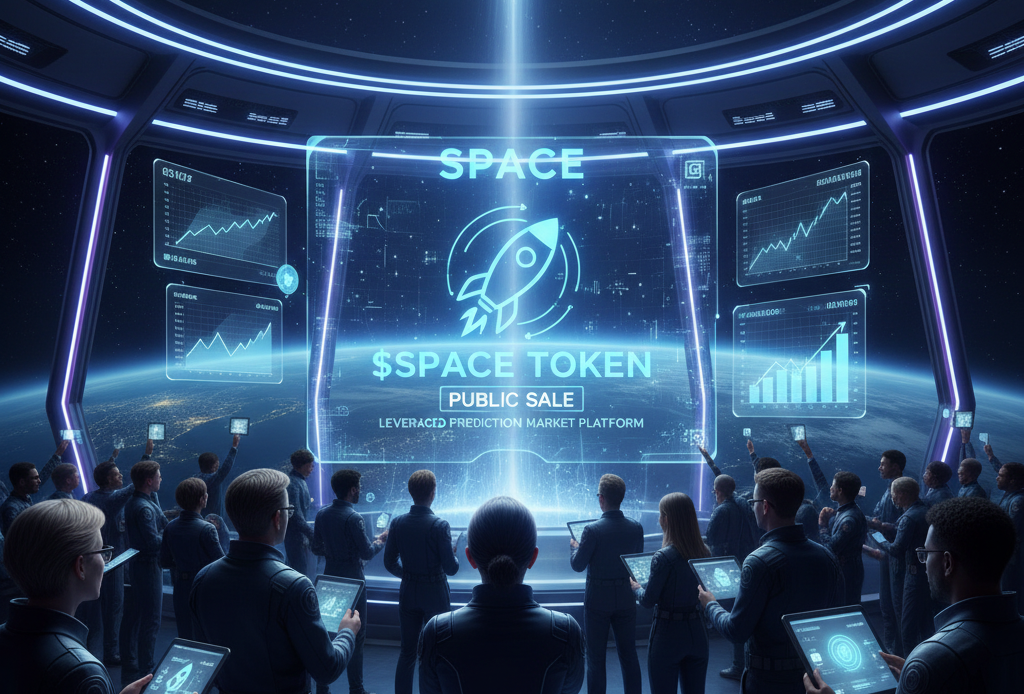
Space just announced the public sale of their native token, $SPACE, kicking off December 17th at 6:00 PM UTC. If you’re not familiar, Space is a prediction market on Solana where you can bet on real-world outcomes—crypto prices, elections, sports, tech launches, whatever—with up to 10x leverage. The pitch is simple: get paid for being right.
The team behind this previously built UFO, which hit a $1.5 billion market cap back in 2021 and cracked the top 100 on CoinMarketCap. They’re bringing that same community-first approach to Space, which is why they’re doing a public sale instead of keeping tokens locked up with VCs and insiders.
Jump Ahead To:
How the Public Sale Actually Works
This isn’t your standard token sale where everyone scrambles to buy at a fixed price. Space is using a variable distribution model with a clearing price mechanism. Here’s how it breaks down:
The sale starts at a $50 million fully diluted valuation (FDV) and stays there until they hit the $2.5 million target. Once that’s reached, price discovery kicks in and the FDV increases linearly up to a $99 million ceiling. At the end, everyone pays the same final clearing price, which is determined by total demand.
So if you buy early at what looks like $50M FDV but demand pushes the final price to $80M FDV, you still pay that higher clearing price—same as everyone else. If demand somehow stays below the target, everyone gets the floor price. It’s designed to prevent early buyers from dumping on latecomers.
No minimum contribution required to participate, no maximum either. You can throw in $50 or $50,000—whatever you want. The sale accepts USDC, USDT, and SOL, and everything unlocks 100% at the token generation event (TGE). No vesting, no cliff, just straight ownership.
The Tier System and Perks
Here’s where it gets a bit more interesting. Every 24 hours, the participation tier changes. Commit early, get a higher tier, which unlocks bigger bonuses and lifetime benefits on the platform.
The perks include:
- Bonus token airdrops
- Points multipliers for seasons 1-4 (throughout 2026)
- Referral multipliers giving you a cut of trading fees from people you bring in
- Trading fee discounts for 12 months
Your tier is permanent once you hit it, and it carries over to your Space profile. So if you’re planning to use the platform long-term, getting in early for a better tier makes sense. If you’re just speculating on the token, probably doesn’t matter as much.
The Buyback and Burn Mechanism
Space is allocating 50% of all platform revenue to buying back and burning $SPACE tokens. The other 50% goes to the protocol treasury. It’s a deflationary model meant to create constant buy pressure as the platform grows.
Whether that actually works depends entirely on how much trading volume Space generates. If the platform takes off and people are betting with 10x leverage on everything from election outcomes to memecoin launches, that revenue could be substantial. If adoption stalls and volume stays low, the buyback won’t move the needle much.
Total supply is capped at 1 billion tokens. Simple, round number. No weird decimal supply trying to pretend scarcity through confusing math.
Who’s Backing This?
Space raised $3 million in seed and strategic funding led by Morningstar Ventures and Arctic Digital. They also did a community raise on Echo that was apparently 1,360% oversubscribed, which sounds impressive but also like the kind of number that gets thrown around in every crypto raise these days.
Impossible Finance and Curated participants also joined. So there’s institutional backing, but the team’s emphasizing that they want community ownership, not VC control. The public sale with no allocation caps is meant to back that up—anyone can participate, not just people with the right connections or minimum ticket sizes.
Does This Actually Solve Prediction Market Problems?
Prediction markets have been around forever in crypto, but most struggle with liquidity. You can’t bet big amounts without moving the market against yourself, which kills the whole point for serious traders. Space is trying to fix this with a central limit order book (CLOB) and 0% maker fees.
The 10x leverage is either a feature or a disaster waiting to happen, depending on how you look at it. On one hand, it amplifies gains when you’re right. On the other, it amplifies losses when you’re wrong, and prediction markets are notoriously difficult to consistently profit from.
They’ve also gamified the whole experience with points, ranks, and seasonal airdrops—basically the playbook every Web3 platform uses now to drive engagement. Whether that creates sustainable activity or just attracts airdrop farmers who vanish once rewards dry up is the question.
Platform Launch Timeline
The public sale starts December 17th. Refunds for any excess contributions (if oversubscribed) happen immediately after the sale closes. TGE follows shortly after that, with the actual platform launching in January 2026.
If you want to participate, head to sale.into.space, connect a self-custodial wallet like Phantom (do NOT send from a centralized exchange or you’ll probably lose your funds), and submit your contribution in USDC, USDT, or SOL. Desktop is recommended because mobile crypto transactions are always janky.
Should You Actually Buy This?
That’s entirely up to your risk tolerance and belief in prediction markets. The team has a track record with UFO, which did genuinely reach a massive market cap before presumably crashing back down like most 2021 projects. They’ve got institutional backing, a real product roadmap, and a mechanism designed to create token value through platform usage.
But it’s also a leveraged prediction market launching in an already crowded space where most traders lose money. The tokenomics look reasonable, the public sale structure seems fair, and the team is at least trying to prioritize community ownership over VC extraction.
Just remember that 10x leverage cuts both ways, token buybacks only matter if there’s actual revenue to fuel them, and “1,360% oversubscribed” doesn’t mean the token will go up after launch. It just means a lot of people wanted to participate in the sale.
Do your own research, don’t invest more than you can afford to lose, all the usual disclaimers apply. But if you’re into prediction markets and want exposure to what might become the leading platform on Solana, at least the entry point seems reasonably fair compared to most token sales.
