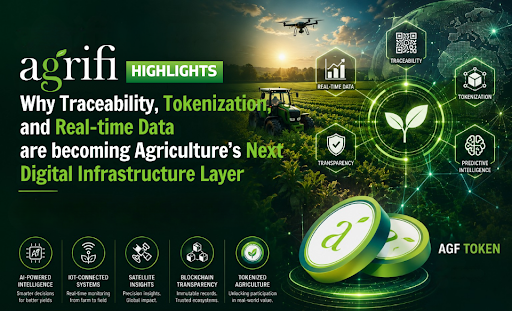
According to the Food and Agriculture Organization (FAO), global food production will need to increase by nearly 70% by 2050 to meet growing population demands. As global food systems face increasing pressure from climate volatility, supply chain disruptions, resource constraints, and growing demands for transparency, agriculture is undergoing one of the most significant technological transformations in its history.
What was once an industry primarily driven by land, labor, machinery, and production outputs is rapidly evolving into a data-driven ecosystem powered by Artificial Intelligence (AI), Internet of Things (IoT) networks, satellite intelligence, blockchain infrastructure, and predictive analytics.
This transition is reshaping how food is produced, monitored, verified, financed, and distributed across global markets.
According to the Food and Agriculture Organization (FAO), global food production will need to increase by nearly 70% by 2050 to meet growing population demands. Simultaneously, the World Bank estimates that climate-related disruptions could significantly impact agricultural productivity in vulnerable regions over the coming decades. At the same time, climate instability, water scarcity, labor shortages, food fraud concerns, and fragmented supply chains are placing unprecedented pressure on agricultural systems worldwide.
The question facing the industry is no longer whether agriculture will digitize, but how quickly.
At the same time, consumers, retailers, governments, and food manufacturers are demanding greater visibility into food origins, production practices, sustainability standards, and supply chain integrity.
These challenges are accelerating the adoption of digital technologies capable of creating more transparent, efficient, and resilient agricultural ecosystems.
Agriculture Is Becoming a Real-Time Intelligence Industry
Agriculture is no longer solely dependent on seasonal observation and historical forecasting.
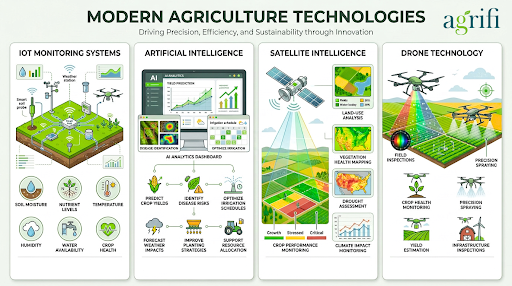
Modern farming operations increasingly utilize:
- AI-powered yield forecasting
- IoT-based soil and environmental monitoring
- Satellite crop intelligence
- Drone-powered field surveillance
- Automated irrigation systems
- Predictive climate analytics
- Blockchain-enabled verification frameworks
Together, these technologies are transforming agriculture into a continuously connected operational environment capable of generating real-time intelligence across entire production ecosystems.
This evolution is helping stakeholders improve:
- Crop productivity forecasting
- Resource utilization efficiency
- Water management efficiency
- Climate adaptation planning
- Supply chain visibility
- Predictive risk management
- Operational decision-making
Agriculture is becoming increasingly predictive rather than reactive.
Rather than reacting to challenges after they occur, agricultural ecosystems are increasingly leveraging data to anticipate and mitigate risks before they impact production.
Why Traceability Is Becoming a Strategic Priority
Food traceability is no longer simply a regulatory requirement.
It is becoming a business necessity.
Consumers increasingly want to know:
- Where products originate
- How crops were produced
- Whether sustainability standards were followed
- How products moved through supply chains
- Whether operational data can be independently verified
Meanwhile, food manufacturers, distributors, retailers, and regulators are demanding higher levels of transparency and accountability.
According to the FAO, approximately one-third of all food produced globally is lost or wasted each year, highlighting major inefficiencies throughout global agricultural supply chains.
This growing demand for visibility is exposing long-standing infrastructure gaps, including:
- Limited supply chain visibility
- Data silos across agricultural operations
- Inconsistent traceability standards
- Manual verification processes
- Delayed operational insights
As agricultural systems become more complex, traditional infrastructure models are struggling to keep pace.
Improving transparency and accountability across these systems is becoming a strategic priority for both public and private sector stakeholders.
Blockchain technology is increasingly being explored as a potential infrastructure layer capable of improving traceability through immutable records, decentralized verification, and auditable data management.
Why Agriculture Is Becoming Increasingly Relevant to Web3
While much of the Web3 industry initially focused on digital assets and decentralized finance, attention is increasingly shifting toward Real-World Assets (RWAs) and industries that generate measurable economic value.
Agriculture represents one of the world’s most important economic sectors because it directly intersects with:
-
- Food Security
- Climate Resilience
- Sustainability initiatives
- Global Trade
- Commodity Markets
- Supply Chain Infrastructure
- Real-world productivity
Industry analysts project that tokenized Real-World Assets could represent one of the largest blockchain growth opportunities over the next decade, as digital infrastructure expands into traditional industries.
Agriculture’s combination of physical assets, operational data, and economic significance makes it particularly relevant to this evolution.
The Emergence of Agriculture-Focused Digital Infrastructure
A growing number of blockchain ecosystems are exploring how agricultural operations, supply chains, and infrastructure can integrate into decentralized digital economies.
Agrifi is among the emerging Polygon-based ecosystems focused on combining:
- Blockchain Infrastructure
- Artificial Intelligence
- IoT-Enabled Monitoring Systems
- Agricultural Data Intelligence
- Tokenized Ecosystem Participation
- AGF Token Utility
The ecosystem is designed around enabling greater transparency, operational visibility, and participation across agriculture-linked digital infrastructure.
Key ecosystem components include:
✔ Agricultural Traceability Frameworks
✔ Blockchain-Backed Transparency Systems
✔ Decentralized Participation Mechanisms
✔ AI-Powered Agricultural Intelligence
✔ Agriculture-Focused Staking Infrastructure
✔ Future Agriculture Utility Applications
Utility-Based Participation and Long-Term Ecosystem Engagement
As decentralized ecosystems mature, many participants are increasingly evaluating projects based on utility, infrastructure value, and long-term sustainability rather than short-term speculation.
Within the Agrifi ecosystem, AGF Token supports participation through staking mechanisms designed to encourage long-term ecosystem engagement.
Current AGF Staking Options
- 30 Days — 5% APY
- 60 Days — 7% APY
- 90 Days — 9% APY
- 120 Days — 12% APY
- 360 Days — Up to 18% APY
The ecosystem also incorporates a 2% early withdrawal fee intended to support participation stability and long-term ecosystem alignment.

Beyond staking, the broader AGF vision focuses on:
- Ecosystem participation
- Governance opportunities
- Agricultural digital infrastructure
- Future agriculture-linked utility applications
- Long-term community engagement
Agriculture’s Future Will Be Built on Data Infrastructure
The next generation of agriculture will likely be defined not only by production capacity but also by the quality, accessibility, transparency, and intelligence of the data supporting it.
Future agricultural ecosystems are expected to rely increasingly on:
- Connected Intelligence Networks
- Real-Time Monitoring Systems
- Predictive Analytics
- Verifiable Supply Chain Infrastructure
- Digital Participation Frameworks
- Data-Driven Decision-Making
As food systems become more complex and interconnected, technologies that improve visibility, accountability, and operational efficiency will continue to play an increasingly important role.
Agriculture is no longer simply a production sector; It is becoming a digital infrastructure sector.
As blockchain, AI, IoT, and Real-World Asset frameworks continue to mature, agriculture may emerge as one of the defining industries shaping the next phase of utility-driven Web3 innovation.
| “Global agriculture is entering a period where transparency, traceability, and intelligence are becoming just as important as production itself. We believe the future agricultural economy will increasingly rely on connected data ecosystems that improve visibility, trust, and participation across the entire value chain. Technologies such as AI, blockchain, and IoT have the potential to help create a more resilient and accountable food system for the future.”
– Veronica Trump, CMO, Agrifi |
About Agrifi
Agrifi is driving an agricultural revolution, harnessing blockchain technology to transform the agricultural supply chain. Our mission is to enhance transparency, efficiency, and sustainability in agriculture while empowering farmers and supporting small-scale agricultural practices.
Join us on this exciting journey to explore the future of agriculture while potentially enhancing the value of your AGF tokens. We’re not just redefining agricultural finance; we’re revolutionizing the future of farming and food production.
Ready to start staking your AGF tokens? Visit our website at https://agrifi.tech/for detailed steps on how to stake your tokens. Compatible wallets include MetaMask, WalletConnect, and Coinbase Wallet. Stay connected with us on Telegram, Twitter, Facebook, and Instagram for the latest updates and community discussions.
Follow Us on:
-
- Website: https://agrifi.tech/
- WhitePaper: https://agrifi.gitbook.io/agrifi-docs
- Blog: https://blog.agrifi.tech
- Telegram: https://t.me/agrifi_official
- Facebook: https://www.facebook.com/agrifiofficial
- Instagram: https://www.instagram.com/agrifi_official/
- Twitter: https://x.com/Agrifi_official
- AGFI listed on: LBank Innovation Zone (AGFI/USDT) LBank