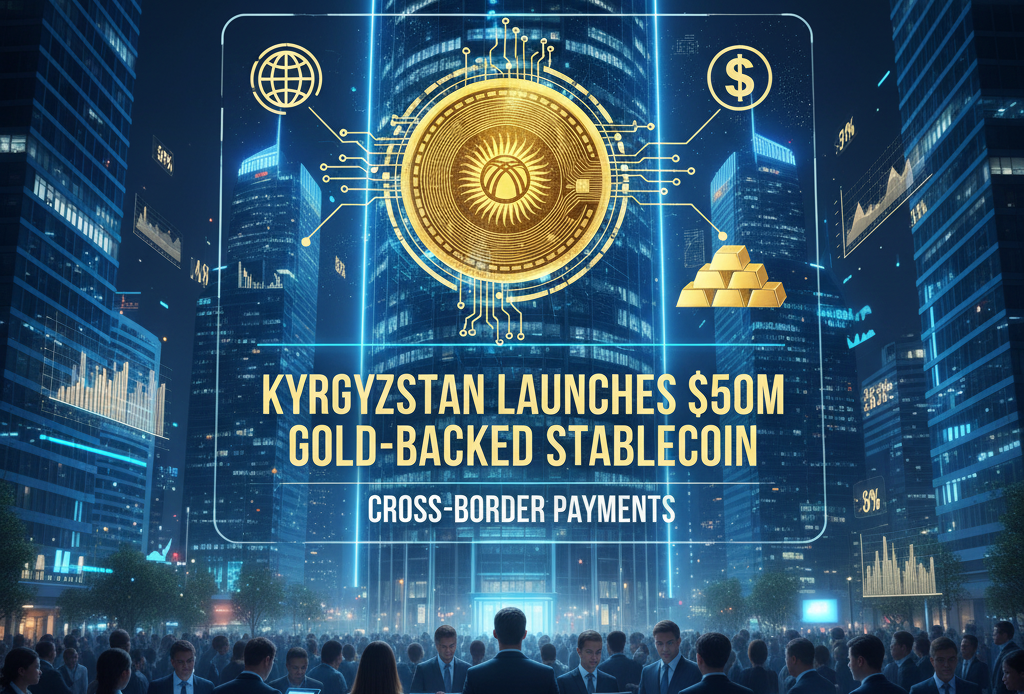
Kyrgyzstan just did something most countries talk about but rarely execute—they launched an actual gold-backed stablecoin. USDKG went live with a $50 million initial issue, pegged 1:1 to the US dollar and fully backed by physical gold reserves. The token’s running on Tron for now, with Ethereum support coming later.
What makes this interesting isn’t just that a government issued a stablecoin. It’s how they structured it. The issuer is OJSC Virtual Asset Issuer, a state-owned entity operating under the Ministry of Finance. But the actual operations—managing the gold reserves, handling redemptions—that’s delegated to a private company registered in Kyrgyzstan. So you’ve got sovereign oversight without full government control of day-to-day operations.
This setup keeps USDKG from being classified as a Central Bank Digital Currency (CBDC), which matters for regulatory reasons and probably helps with international adoption. CBDCs carry political baggage. A state-backed stablecoin with private operational management? That’s a different conversation entirely.
Jump Ahead To:
The Launch Was Actually Pretty Official
President Sadyr Japarov showed up for the launch ceremony, along with Finance Minister Almaz Baketaev and Biibolot Mamytov, CEO of Gold Dollar, which operates the project. They literally pressed a symbolic “Launch Issuance” button to start circulation. You don’t get much more official than having the president physically launch your stablecoin.
The initial 50 million USDKG tokens are all backed by physical gold sitting in vaults somewhere in Kyrgyzstan. ConsenSys Diligence audited the whole setup, which provides some credibility—they’re not exactly known for rubber-stamping questionable projects.
The company managing the reserves has already outlined expansion plans. Next phase targets $500 million in backing, with a long-term goal of $2 billion. Whether they hit those numbers depends on adoption, but the ambition is clear.
Does Gold Backing Actually Matter?
Here’s the thing about gold-backed stablecoins: they sound great in theory. Gold is tangible, inflation-resistant, universally recognized as valuable. Backing a digital token with physical gold should create stability that algorithmic stablecoins can’t match and transparency that fiat-backed stablecoins often lack.
In practice, it’s messier. You’re trusting that the gold actually exists, that audits are legitimate, and that you can redeem tokens for dollars (or gold) when you need to. USDKG requires standard KYC/AML verification for redemptions, which is reasonable for compliance but adds friction that pure crypto users hate.
Still, the gold backing does differentiate USDKG from Tether or USDC, which rely on reserves of dollars and dollar-equivalents. Those work fine until people start questioning whether the reserves actually match the circulating supply. Gold sitting in a vault is harder to fake, assuming the audits are real.
Why Central Asia, Why Now?
Kyrgyzstan passed a Law on Virtual Assets back in 2022, which created the legal framework for this entire project. They’re among the first countries in Central Asia to establish comprehensive digital asset regulations, and USDKG represents the most ambitious execution of that framework so far.
Government representatives made a point of saying this isn’t some geopolitical play—they’re not trying to bypass sanctions or challenge the dollar’s dominance. USDKG is positioned as a tool for financial inclusion and cross-border payment efficiency. Whether you believe that framing or see it as diplomatic cover is up to you.
The reality is probably somewhere in the middle. Cross-border payments in Central Asia are genuinely clunky and expensive. Traditional banking infrastructure doesn’t always reach remote areas. A stablecoin that facilitates faster, cheaper transactions while staying compliant with international standards could solve real problems.
But it’s also true that state-issued digital assets give governments more visibility into financial flows and reduce reliance on Western payment rails. Both things can be true simultaneously.
What Happens If This Actually Works?
If USDKG gains traction—and that’s a big if—it could set a template for other emerging markets. The model here is interesting: state backing for legitimacy and regulatory clarity, private operations for efficiency, gold reserves for stability, blockchain for transparency. It’s not a CBDC, it’s not purely private, it’s somewhere in between.
The biggest challenge is adoption. Getting institutions and individuals to trust a stablecoin from Kyrgyzstan requires overcoming skepticism about both the country’s economic stability and the project’s long-term viability. Starting with $50 million is smart—it’s big enough to be taken seriously but small enough that failure wouldn’t be catastrophic.
ConsenSys Diligence’s involvement helps. Tron’s network gives them speed and low transaction costs, even if it’s not most people’s first choice for blockchain infrastructure. Adding Ethereum support later addresses that concern.
Government officials emphasized that USDKG “complements, rather than competes with, the national monetary system.” That’s the line every government issuing digital assets has to walk—innovate without threatening the existing financial order. Whether they can actually thread that needle remains to be seen.
For now, Kyrgyzstan’s taken a real swing at building something different. A gold-backed, state-supervised, privately-operated stablecoin designed for cross-border payments and financial inclusion. The pieces are in place. Whether anyone actually uses it is the question that matters.